Rome Free Walking Tour
2h30 · rated 9.1/10 in 512 reviews
Guided in English
Reserve a spotRome gives away more than most capitals, because so much of it is outdoors or inside a church. St Peter's Basilica costs nothing. Neither do the Caravaggios in three churches near Piazza Navona, Michelangelo's Moses, the Gianicolo and Pincio viewpoints, or a walk down the Appian Way. Some things have changed, though. The Pantheon now charges tourists, and since February 2026 the edge of the Trevi Fountain costs €2 by day. Museums come down to two dates: the first Sunday of the month for state and city sites, the last Sunday for the Vatican Museums. Everything below was checked against official sources in October 2026.
These have no fixed price. You reserve a spot, and at the end you tip the guide what you think the tour was worth.
2h30 · rated 9.1/10 in 512 reviews
Guided in English
Reserve a spotSpots are booked through Civitatis.
Open to everyone, every day they are open. No ticket to buy.
The largest church in the world, with Michelangelo's Pietà just inside on the right and Bernini's bronze canopy over the altar. Walking in costs nothing. Only the dome climb and the timed-entry slot with audio guide are paid.
A small museum inside Porta San Sebastiano, the biggest gate of the Aurelian Walls. The exhibits are modest. The point is climbing the towers and walking a stretch of the third-century rampart.
Inside Porta San Pancrazio, at the top of the Gianicolo, this small museum tells the story of the 1849 Roman Republic and Garibaldi's defence of the hill with maps, uniforms and video.
The French national church holds three Caravaggio canvases on the life of St Matthew in the Contarelli Chapel, last on the left. The Calling of St Matthew alone would be the star of any museum.
Two Caravaggios face each other in the Cerasi Chapel, left of the altar: the Crucifixion of St Peter and the Conversion of St Paul. The Chigi Chapel, second on the left, was designed by Raphael and finished by Bernini.
Caravaggio's Madonna of the Pilgrims is in the first chapel on the left, still in the spot it was painted for. Raphael's fresco of the prophet Isaiah is on the third pillar of the nave.
Michelangelo's Moses sits at the centre of the tomb of Julius II, in the right transept. Under the main altar are the chains said to have bound St Peter, which give the church its name.
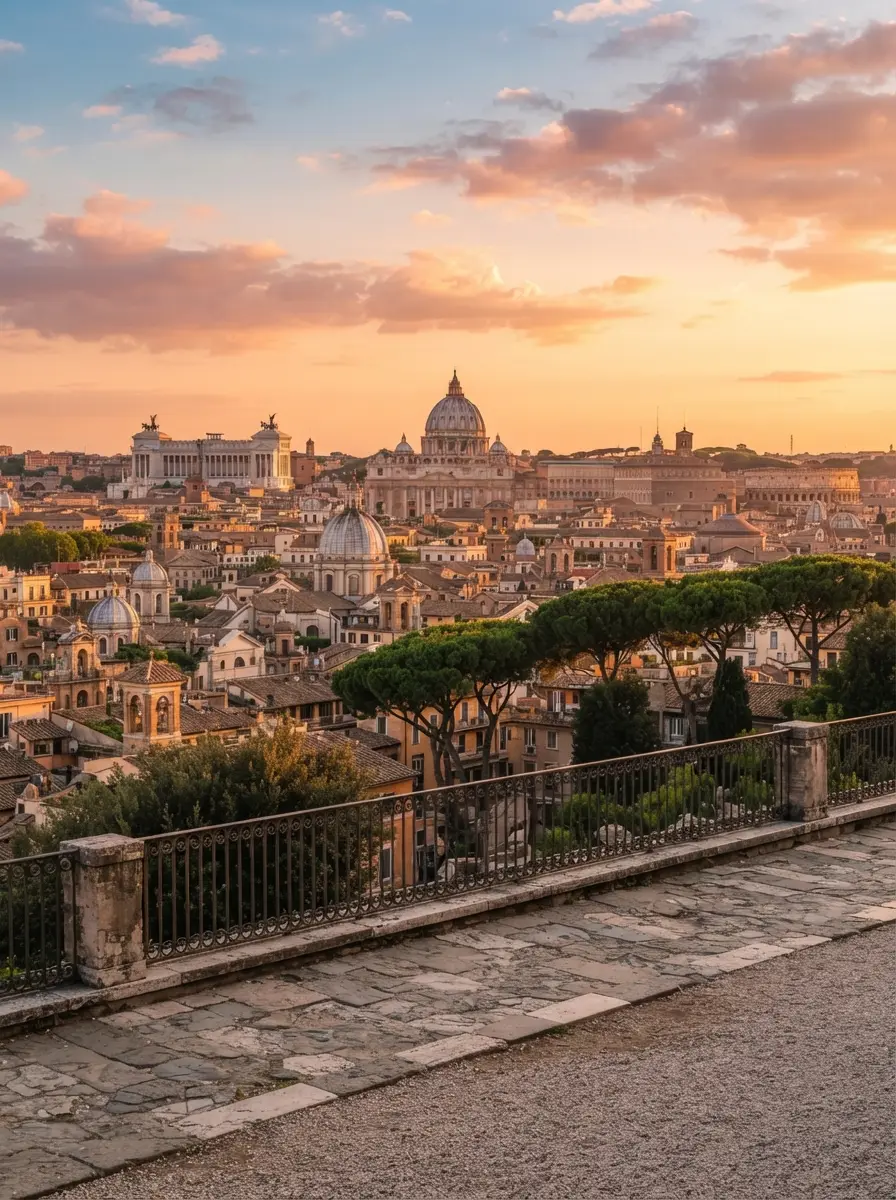
The widest view over Rome's domes and rooftops, from the terrace by the Garibaldi monument. A cannon just below fires a single blank at 12:00 every day, a tradition since 1904.
The balcony above Piazza del Popolo, looking west across the rooftops to the dome of St Peter's. It is the classic place to watch the sun go down in Rome.
A walled garden of bitter orange trees on the Aventine, with a terrace over the Tiber and a straight sightline to St Peter's. Its official name is Parco Savello.
The central park of Rome: 80 hectares of umbrella pines, a small lake with a temple on an island, fountains and the oval of Piazza di Siena. The Borghese Gallery inside is paid, the park is not.
The original Roman road south, still paved in places with basalt slabs rutted by cart wheels and lined with tombs and pines. Walking it is free every day. On Sundays and public holidays motor traffic is banned along the whole route.
A covered neighbourhood market with about 100 stalls: produce, butchers, fishmongers and a row of counters selling sandwiches and pasta. Roman warehouse remains found during construction lie underneath.
A shaded burial ground beside the Pyramid of Cestius where Keats and Shelley lie, along with Gramsci and Goethe's son. Cypress trees, cats and some of the best funerary sculpture in the city.
A long oval square built on the footprint of Domitian's stadium, with Bernini's Fountain of the Four Rivers in the centre and Borromini's church of Sant'Agnese facing it.
The Pope's weekly public audience, held in St Peter's Square in good weather or in the Paul VI Hall. Tickets are always free, whatever resellers charge online.
Since 2 February 2026 tourists pay €2 to go down to the basin edge during the day. Looking at the fountain from the piazza, a few steps back, is still free at any hour, and after closing time the barriers stop charging.
Open fields crossed by the arches of the Aqua Claudia and six other Roman aqueducts, eight kilometres from the centre. Sheep graze here and locals jog under the arches.
Rome's Sunday flea market, more than a kilometre of stalls from the Porta Portese gate down Via Portuense. Mostly cheap clothes and phone cases near the gate, with secondhand books, records and bric-a-brac further in.
A morning market on the square where Giordano Bruno was burned in 1600. His hooded statue stands in the middle. These days the stalls sell as many spice mixes and limoncello bottles as vegetables.
Mostly museums. The free window, who it applies to and the booking rule are on each card.
The Colosseum and the Forum and Palatine area open free on the first Sunday of the month under the state's Domenica al Museo scheme. You get the standard route only. The arena floor, underground and the SUPER sites on the Palatine stay shut.
The Pantheon has charged visitors since 2023, but the first Sunday of the month is still free for everyone. Two thousand years old, and the dome with its open oculus is still the best interior in Rome.
Hadrian's tomb turned papal fortress, with a spiral ramp, frescoed apartments and a roof terrace facing St Peter's. Free on the first Sunday of the month, full price the rest of the time.
The national gallery of old masters: Caravaggio's Judith Beheading Holofernes, Raphael's La Fornarina and Pietro da Cortona's enormous ceiling. Free on the first Sunday, along with its sister gallery, Palazzo Corsini in Trastevere.
The ruins of a third-century bath complex built for 1,600 bathers at a time, with brick walls still standing 30 metres high and patches of mosaic floor. A state site, so free on the first Sunday.
The city's own collection on Michelangelo's square: the bronze She-wolf, the original Marcus Aurelius on horseback, the Dying Gaul, and a gallery that looks straight down on the Forum. Non-residents pay €16.50 on other days.
A multi-storey Roman complex of shops and offices cut into the Quirinal hill, now the museum of the Imperial Fora. You walk the ancient street, Via Biberatica, and look out over Trajan's Forum from the upper terraces.
The full museum route, Raphael Rooms and Sistine Chapel included, with no ticket on the last Sunday of each month. Normal entry costs €20 or more, so this is the biggest single saving in Rome.
Not for tourists on normal days. It is free for everyone on the first Sunday of the month, with free tickets handed out at the desks and no online booking. Rome residents do not pay.
Only to go down to the water's edge. Since 2 February 2026 tourists pay €2 for the basin area between 9:00 and 22:00 (from 11:30 on Mondays and Fridays). Viewing from the piazza is free at any hour.
Yes, along with the Roman Forum and Palatine. Free tickets cannot be reserved. You collect them in person the same day at the ticket offices in Piazza del Colosseo or Largo della Salara Vecchia.
On the last Sunday of each month, 9:00–14:00 with final entry at 12:30, unless it falls on Easter, 29 June or 25, 26 or 31 December. There is no booking, and the queue often reaches two hours.
Only on the first Sunday of the month. Since February 2026 they are free all year for residents of Rome and its metropolitan area. Four small ones stay free for everybody: Museo delle Mura, Museo della Repubblica Romana, Casal de' Pazzi and Casa Museo Alberto Moravia.
Bernini's Apollo and Daphne and the Rape of Proserpina are here, plus six Caravaggios, and no church or free Sunday elsewhere comes close for sculpture. Entry is by two-hour timed slot with capped numbers, so you can stand in front of the marble without a crowd. Book a week or more ahead.
Everything above is free. This is the only paid pick on the page, chosen because no free option replaces it.
See tickets and prices